
UniNeuro: A Unified EEG Foundation Model
for Heterogeneous EEG Task Learning
¹ School of Computer Science and Technology, Tongji University, China
² Shanghai Eye Disease Prevention and Treatment Center, China
10–14 November
Introduction
EEG tasks in human-centered multimedia differ in temporal scales, neural patterns and label semantics. Most foundation models require task-specific fine-tuning. Can we jointly learn heterogeneous EEG tasks in a unified discriminative framework?
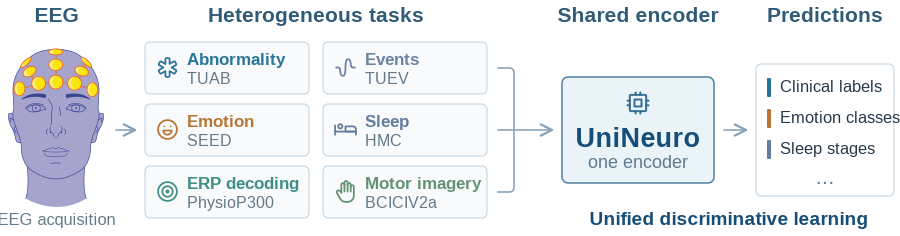
>10,000 h pretraining6 downstream tasks11M / 27M / 86M model scales
Challenges & Contributions
Unified learning faces two key challenges: balancing feature sharing and task specialization inside a shared backbone, and organizing the latent space under heterogeneous joint training.
- Unified discriminative framework. Heterogeneous-task pretraining and joint downstream adaptation share a single learning pipeline.
- Gradient-reversal task-conditional MoE. Shared experts capture task-invariant EEG structure; routed experts preserve task-specific patterns.
- Hierarchical prototype learning. Task and task-conditioned label prototypes organize coarse task semantics and within-task class structure.
- Six-task joint evaluation. UniNeuro improves unified discrimination and narrows the gap to task-specific fine-tuning.
Method Unified EEG Foundation Model · Task-conditional MoE · HPGCL
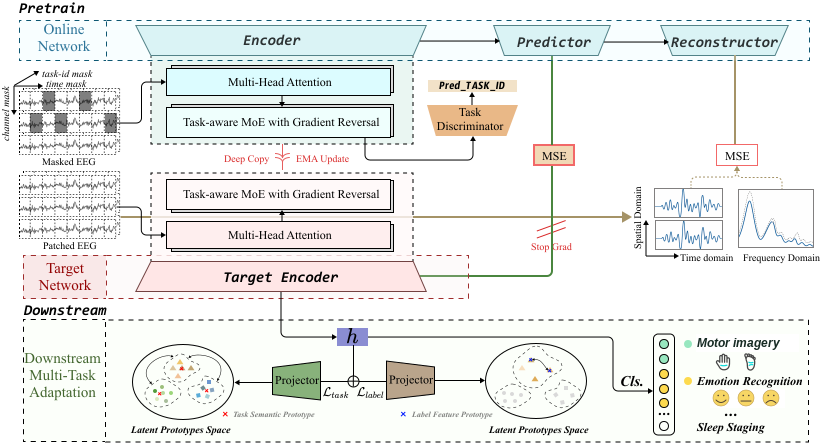
Online–target pretraining
- Online–target networks. Align latent predictions with EMA targets to reduce overfitting to EEG noise.
- Reconstructor. Reconstruct EEG in temporal, spatial (channel-level) and frequency domains.
- Task discriminator. Task prediction and gradient reversal decouple shared and task-specific features.
Unified downstream adaptation
- Task-level projector. Align features with task prototypes to form task-level clusters.
- Label-level projector. Align features with task-conditioned label prototypes.
- Unified classifier. Predict dataset-conditioned labels from encoder features.
Unified Downstream Multi-task Evaluation Balanced accuracy (%) ↑
UniNeuro-Large improves BA over NeuroLM on all six benchmarks.
Gain over NeuroLM+12.53 pp TUEV+13.06 pp SEED+11.47 pp BCICIV2a
| Model | Multi-task | TUABAbnormality | TUEVEvents | SEEDEmotion | HMCSleep | PhysioP300ERP | BCICIV2aMotor imagery |
|---|---|---|---|---|---|---|---|
| BIOT | — | 79.59 ± 0.57 | 52.81 ± 2.25 | 70.97 ± 0.24 | 68.62 ± 0.41 | 54.85 ± 3.25 | 45.90 ± 1.96 |
| LaBraM | — | 81.40 ± 0.19 | 64.09 ± 0.65 | 73.18 ± 0.19 | 72.86 ± 1.01 | 64.77 ± 1.10 | 56.13 ± 0.58 |
| EEGPT | — | 79.83 ± 0.30 | 62.32 ± 1.14 | 72.28 ± 0.68 | 73.44 ± 1.20 | 65.02 ± 0.63 | 58.46 ± 0.70 |
| NeuroLM | ✓ | 78.26 ± 0.65 | 45.60 ± 0.48 | 55.54 ± 0.75 | 67.37 ± 0.50 | 52.92 ± 1.43 | 43.14 ± 1.33 |
| Ours-Tiny | ✓ | 77.23 ± 0.75 | 55.84 ± 0.96 | 66.26 ± 0.16 | 66.52 ± 1.20 | 55.17 ± 0.90 | 52.49 ± 0.15 |
| Ours-Base | ✓ | 79.12 ± 0.35 | 57.39 ± 0.25 | 68.35 ± 0.47 | 66.73 ± 1.38 | 56.20 ± 0.67 | 54.15 ± 0.22 |
| Ours-Large | ✓ | 79.64 ± 0.67 | 58.13 ± 0.61 | 68.60 ± 0.13 | 67.50 ± 1.12 | 57.46 ± 0.13 | 54.61 ± 0.67 |
256 Hz sampling · 4 s windows · Three seeds · Mean ± SDTiny → Large: BA increases on all six tasksBest overall Best multi-task
Ablation & Representation Analysis
Task-aware MoE
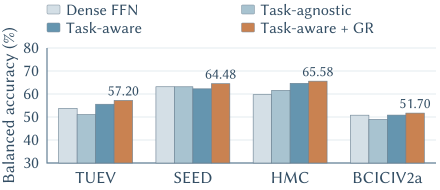
to task-aware MoE (mean BA).
HPGCL objectives
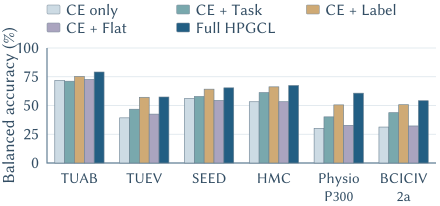
Full HPGCL 64.02% (+17.04 pp vs CE).
Task and label representations
Task-level structure
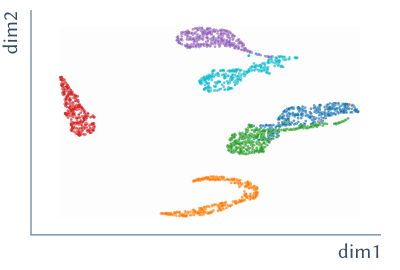 CE only
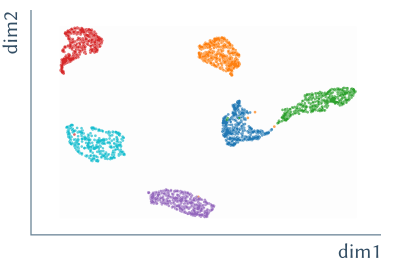 HPGCL
Silhouette 0.5431 → 0.6788
SEED label separation
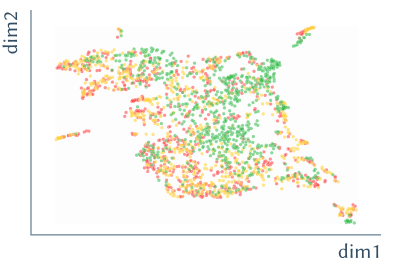 CE only
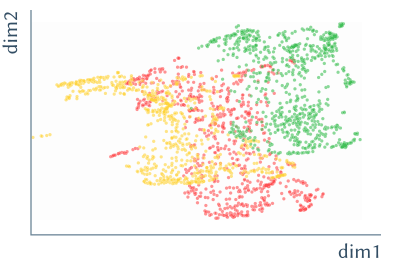 HPGCL
Silhouette 0.0824 → 0.2779